
Summary
- From 1 July 2026, higher salary thresholds will apply to employer-sponsored visas, increasing compliance and cost obligations for businesses.
- Changes to visa processes and occupation classifications may affect recruitment planning, sponsorship eligibility and workforce strategy.
- Employers must proactively review salaries, budgets and training programs to avoid delays, non-compliance and operational disruption.
- This article explains upcoming changes to Australia’s employer-sponsored visa framework for business owners in Australia and provides a practical guide to workforce planning.
- LegalVision, a commercial law firm that specialises in advising clients on immigration and employment compliance, outlines how businesses can prepare for regulatory changes.
Tips for Businesses
Review your sponsored employees’ salaries and align them with upcoming thresholds before 1 July 2026. Plan visa applications early to avoid delays, budget for increased costs and ensure training programs meet stricter requirements. Monitor occupation classification updates and adjust recruitment strategies to stay compliant and competitive.


The Australian Government continues to reform the employer-sponsored visa framework as part of its 10-Year Migration Strategy. Accordingly. If your business sponsors overseas workers, you should be aware of upcoming changes that will affect salary requirements, visa costs and occupation classifications from 1 July 2026 onwards. Therefore, you should review your salary structures, sponsorship budgets and recruitment plans.
This article outlines the key changes and provides practical guidance on how employers can prepare for these developments.
Increase to Employer-Sponsored Visa Salary Thresholds (From 1 July 2026)
The Australian Government will increase minimum salary thresholds for employer-sponsored visas from 1 July 2026.
These thresholds apply to both:
- Subclass 482 – Skills in Demand visa; and
- Subclass 186 – Employee Nomination Scheme visa.
Following the release of the November 2025 Average Weekly Ordinary Time Earnings (AWOTE) data by the Australian Bureau of Statistics, the indexed thresholds for the 2026–27 program year will be:
- Core Skills Income Threshold (CSIT): $79,499 (previously $76,515); and
- Specialist Skills Income Threshold: $146,717 (previously $141,210).
These thresholds will apply to all relevant visa applications lodged on or after 1 July 2026.
Increase in Visa Application Charges
Visa application charges (VAC) have increased significantly across various visa categories in recent months. Most notably:
- Subclass 485 (Temporary Graduate) visa: The base application charge increased to $4,600 from 1 March 2026; and
- Subclass 500 (Student) visa: Fees increased to $1,600 from 1 July 2025, with further increases to $2,000 in some contexts.
Although the Government has not announced specific increases to employer-sponsored visas, you should anticipate potential fee adjustments. You should also factor these into your sponsorship budgets.
Continue reading this article below the formCall 1300 544 755 for urgent assistance.
Otherwise, complete this form, and we will contact you within one business day.
Updates to Training Visas
The Migration Amendment (Training Visas—Sponsorship Requirements) Regulations 2026 take effect from 11 March 2026 and introduce an important procedural change for Subclass 407 (Training) visa applications.
Why This Change Matters
This amendment addresses concerns about the integrity of the Subclass 407 visa program and aims to prevent misuse of training visas. By requiring nomination approval before visa lodgement, the Department of Home Affairs can:
- Assess the genuineness of training programs upfront: The Department will scrutinise whether the proposed training genuinely enhances skills that are not readily available in the visa applicant’s home country, before the visa application proceeds.
- Prevent ungenuine arrangements: The sequential process creates a stronger safeguard against arrangements where training visas are used as a pathway to work in Australia without legitimate training outcomes, or where the “training” is merely a pretext for filling labour shortages.
- Ensure compliance with training requirements: Nomination approval confirms that the training program meets regulatory requirements, including structured training plans, appropriate supervision, and genuine occupational training objectives.
What This Means for Employers
Employers sponsoring overseas workers for training purposes should be aware that:
- Nomination must be approved first: You cannot lodge a visa application until the Department of Home Affairs approves the nomination;
- Visa application follows nomination approval: The applicant must wait for nomination approval before applying for the visa;
- Processing times may increase: Applications will now be processed sequentially rather than concurrently;
- Plan training earlier: Start the nomination process sooner to avoid delays to training programs; and
- Training must be genuine and structured: Training plans, supervision, and outcomes will face closer scrutiny before a visa application proceeds.
This change aligns the Subclass 407 visa process with other employer-sponsored visas and reinforces the need for genuine, structured training that delivers meaningful skills development.
Public Consultation Regarding OSCA
The Australian Bureau of Statistics (ABS) is undertaking an occupation-level update of the Occupation Standard Classification for Australia (OSCA). The revised classification is scheduled for release in March 2027.
Consultation Timeline
The ABS will run a public consultation from Wednesday, 11 March to Friday, 24 April 2026. During this period, the ABS will seek feedback on whether existing occupation classifications accurately reflect current roles across Australian industries.
In particular, the consultation aims to identify:
- occupations currently listed in OSCA that are not accurately described; and
- occupations that should be separately identified with their own unique OSCA code.
Scope of the OSCA 2027 Update
The March 2027 update will focus on the six-digit occupation level and will include:
- separately identifying new and emerging occupations;
- retiring occupations that no longer meet the minimum threshold for statistical balance;
- modifying skill levels; and
- updating occupation elements, including specialisations, titles, lead statements, main tasks, licensing and registration requirements.
These changes aim to ensure that the classification system reflects how work is performed across the Australian economy.
Why This Matters for Employers
The Department of Home Affairs currently relies on the Australian and New Zealand Standard Classification of Occupations (ANZSCO) 2022 to determine appropriate occupations for employer-sponsored visa programs, including Subclass 482 and Subclass 186 visas.
If the Government later updates the skilled occupation list or the ANZSCO framework, these changes could affect employer sponsorship in several ways.
In practical terms, future changes could lead to:
- changes to which occupations are eligible for employer sponsorship;
- modifications to occupation descriptions that affect how roles are nominated;
- updates to skill level classifications that influence salary requirements; and
- the introduction of new occupation codes for emerging roles in your industry.
The ABS has published a provisional set of proposed OSCA 2027 changes as an Excel dataset on their website. If your business sponsors overseas employees or plans to do so, reviewing these provisional changes can help you understand potential future directions.
How Should Employers Prepare for These Changes?
1. Lodge Pending Applications Before 1 July
If your business is preparing for employer-sponsored visa applications, you should consider lodging them before 1 July 2026.
2. Review Current Salaries of Sponsored Employees
You should review the salaries of all employees sponsored under the Subclass 482 visa or preparing to transition to Subclass 186 permanent residency. Employees earning close to the current CSIT may require salary adjustments to meet the new $79,499 threshold.
Remember that these are minimum thresholds. The actual salary must also align with the Annual Market Salary Rate (AMSR) for the occupation
3. Budget for Increased Costs
When planning your 2026–27 workforce budget, you should account for higher minimum salaries for sponsored employees, potential increases to visa application charges and any administrative costs associated with adjusting employment contracts or remuneration structures.
4. Participate in OSCA Consultation
If your business regularly sponsors employees in specific occupations, you should consider participating in the OSCA consultation process. This is an opportunity to:
- Provide feedback on occupation descriptions that don’t accurately reflect your industry;
- Advocate for separate classification of emerging roles in your sector; and
- Ensure the classification remains relevant to your workforce needs.
5. Monitor Occupation Classifications
Although OSCA is not currently used for employer-sponsored visas, reviewing the provisional OSCA 2027 changes may provide insight into how occupation classifications are evolving. This may help you anticipate potential future changes to ANZSCO or employer-sponsored occupation lists.
Understanding these trends can assist you with:
- long-term workforce planning for sponsored employees;
- identifying emerging occupations that may become relevant to your business; and
- staying informed about how your industry’s occupations are being classified and described.
6. Plan Ahead for March 2027
The ABS will release the final OSCA 2027 classification in March 2027. While the update will not immediately affect visa applications, you should monitor whether the Government later incorporates changes into the migration frameworks.
If future updates to employer-sponsored occupation lists occur, you may need to:
- review whether your commonly sponsored occupations remain on the relevant skilled occupation lists;
- assess whether occupation code changes affect your nomination applications;
- update position descriptions to align with any revised occupation definitions; and
- reassess skill levels and associated salary requirements if classifications change.
Key Dates to Remember
| 11 March – 24 April 2026: OSCA public consultation period |
| 1 July 2026: New CSIT ($79,499) and SSIT ($146,717) thresholds take effect |
| March 2027: OSCA 2027 classification released |
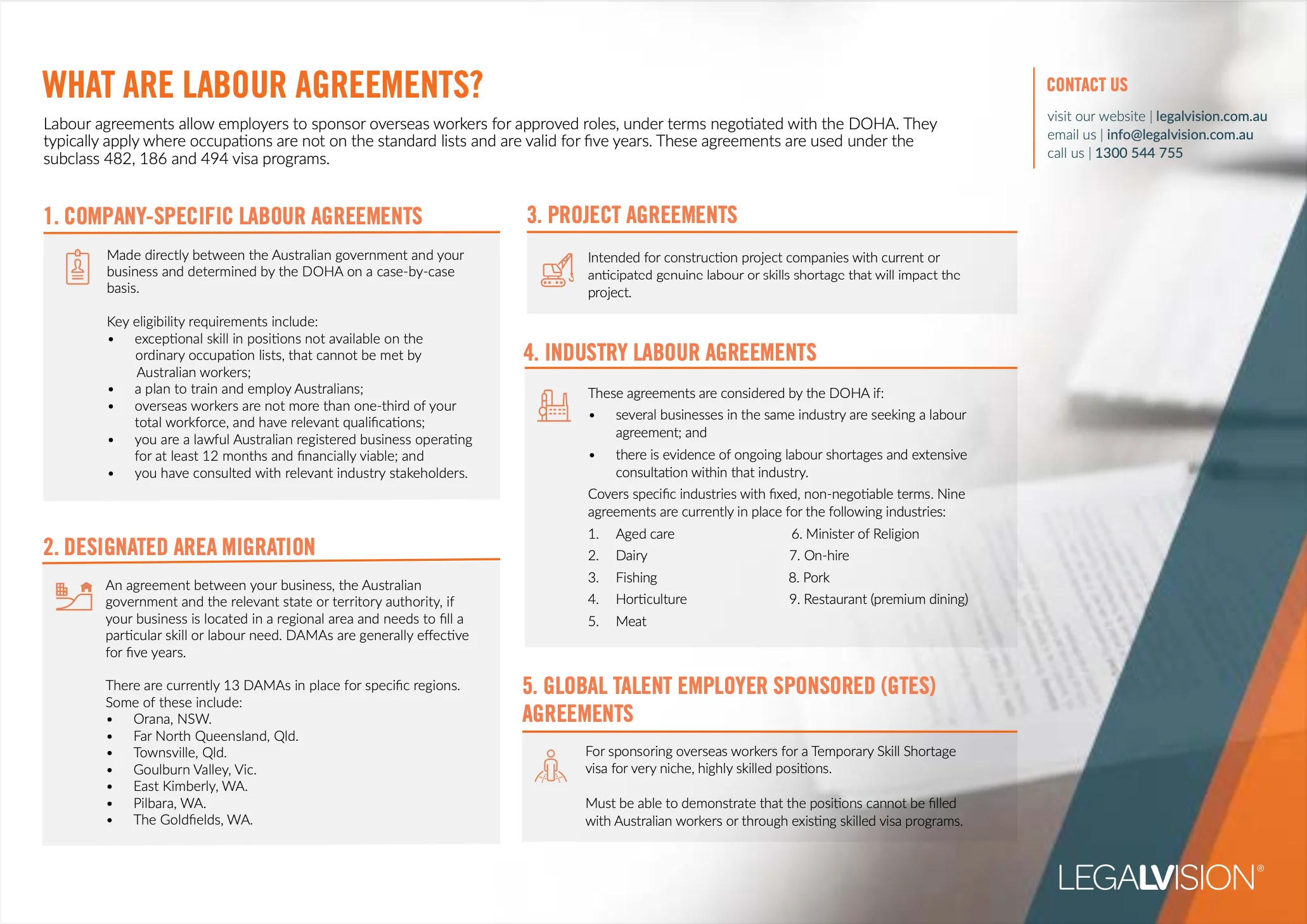
Labour agreements allow employers to sponsor overseas workers for approved roles, under terms negotiated with the DOHA. This factsheet outlines five different types of labour agreements and when they might apply to your business.
Key Takeaways
The employer-sponsored visa framework continues to evolve, and staying ahead of these changes is essential for maintaining compliance and managing your sponsored workforce effectively. Changes to visa requirements can affect your recruitment plans, sponsorship obligations and workforce budgets. Seeking legal advice can help you understand your responsibilities and ensure your sponsorship arrangements remain compliant.
LegalVision provides ongoing legal support for businesses through our fixed-fee legal membership. Our experienced immigration lawyers help businesses manage contracts, employment law, disputes, intellectual property, and more, with unlimited access to specialist lawyers for a fixed monthly fee. To learn more about LegalVision’s legal membership, call 1300 544 755 or visit our membership page.
Frequently Asked Questions
From 1 July 2026, the Australian Government will increase the minimum salary thresholds for employer-sponsored visas. The Core Skills Income Threshold will rise to $79,499 and the Specialist Skills Income Threshold to $146,717. These thresholds apply to Subclass 482 and Subclass 186 visa applications lodged on or after this date.
The AMSR is the market salary for a role in Australia. You must pay sponsored employees at least the AMSR, even if it exceeds the minimum visa salary thresholds.
Employers should review the salaries of sponsored employees, consider lodging visa applications before 1 July 2026, and budget for higher salaries and visa costs. You should also monitor changes to occupational classification and consider participating in the OSCA consultation process to ensure industry roles are accurately represented.
Participating in consultation allows employers to influence how roles are classified, ensuring occupation definitions reflect industry practice and support future sponsorship eligibility.
We appreciate your feedback – your submission has been successfully received.