
Summary
- Directors who allow a company to incur debts whilst insolvent face serious personal liability, including loss of personal assets and potential bankruptcy.
- The safe harbour provisions under the Corporations Act 2001 (Cth) can protect directors from civil liability if they act promptly and responsibly upon suspecting insolvency.
- Cooperating fully with a liquidator and seeking advice early are critical steps in limiting personal exposure.
- This article explains insolvent trading laws and director obligations under Australian law, serving as a plain-English guide for business owners and directors.
- It has been prepared by LegalVision, a commercial law firm that specialises in advising clients on corporate insolvency and director duties.
Tips for Businesses
Monitor your company’s cash flow regularly and act immediately if debts cannot be met. Avoid incurring new debts when insolvency is suspected, seek financial and legal advice promptly, maintain accurate records, and cooperate fully with any appointed liquidator to reduce personal liability exposure.


Insolvency occurs when a company can no longer pay its debts as they fall due. As a director, you are legally obligated to monitor your company’s financial health and act swiftly if insolvency looms. Recent global instability has placed significant financial pressure on Australian businesses, increasing insolvency risks for directors. Trading while insolvent can have serious consequences and may expose your personal finances to pay off the debts of the company. This article will explain the risks of insolvency and how to minimise them.
What is Insolvent Trading
Under the Corporations Act 2001 (Cth), a company is insolvent when it is unable to pay its debts as and when they fall due. Insolvent trading occurs when a director allows a company to incur new debts while the company is insolvent, or where incurring the debt would cause the company to become insolvent.
Directors have a duty to prevent the company from incurring debts when they knew, or ought to have known, that the company was insolvent at the time. This duty applies to each individual director, regardless of whether other directors were also involved in the decision.
What are the Risks?
The risks of insolvent trading, particularly for directors, are very serious. Unlike many other corporate liabilities, insolvent trading claims pierce the corporate veil, meaning the protection that a company structure ordinarily provides to its directors is removed. This exposes you personally to financial and legal consequences that can be far-reaching and long-lasting.
It is important to note that your Directors and Officers (D&O) insurance is unlikely to cover insolvent trading claims, especially since:
- most policies explicitly exclude fraudulent or criminal conduct; and
- coverage gaps can leave directors personally exposed.
Risks of insolvent trading come in the form of:
- disqualification;
- civil fines;
- civil compensation claims; and
- criminal penalties.
Penalty Severity
The type of penalty will depend on the severity of the breach and any surrounding circumstances. More specifically, the penalties have been laid out below:
| Penalty | Explanation |
| Disqualification | ASIC has the power to disqualify directions, either automatically upon criminal conviction or by order following a civil finding. Disqualification can be permanent or for a specified period of time. |
| Civil Fines | Civil pecuniary penalties can be as high as $200,000. |
| Compensation | Australian Securities and Investments Commission (ASIC) can sue directors to recover money for creditors, and liquidators or creditors can also bring claims personally. This can put your personal assets at risk, including your home, bank accounts, and investments. If those assets are not enough, you may be declared bankrupt. Bankruptcy means you can not act as a director, you lose control of your assets, may face travel and employment limits, and will struggle to get credit. Your details are permanently recorded on the National Personal Insolvency Index, and bankruptcy usually lasts three years but can be extended. |
| Criminal Penalties | Where insolvent trading is found to be dishonest or fraudulent, directors face criminal prosecution, which can result in fines and up to five years’ imprisonment. |
Call 1300 544 755 for urgent assistance.
Otherwise, complete this form, and we will contact you within one business day.
How to Minimise the Risks of Insolvent Trading
Stay Informed
As a director, you must do a number of things to stay informed about the financial position of the company, including:
- understanding your duties as a director;
- keeping all financial records and other information that may be relevant to the finances of the company; and
- gaining an understanding of the cash flow of the company.
Investigate
If the company is not in a strong financial position, you should be quick to:
- take steps to understand where exactly the company stands financially;
- look at what can be done to manage the financial instability;
- avoid taking on new debts;
- consider areas of the business that could be made leaner by making staff redundant;
- ensure the company has systems to assess whether or not the company will remain solvent upon taking any new debts.
Overall, you must be very involved in your company and should know exactly where the company’s money is being spent.
Obtain Advice
When it comes to obtaining advice, you should act quickly. You will need to find the right financial adviser and get advice about the financial stability of the company. They will be able to guide you on how you may be able to overcome the obstacles.
You can rely on this advice as a defence to any potential legal claims that may arise out of the company’s insolvency. The availability of this defence, however, hinges on whether you have given your accountant complete and up-to-date instructions.
Insolvency Safe Harbour
In certain circumstances, you may be protected from civil insolvent trading liability under the safe harbour provisions of the Corporations Act. The safe harbour provisions exclude liability if:
- after you started to suspect that your company may become insolvent, you started to courses of action that were reasonably likely to lead to a better outcome; and
- the debt was incurred directly or indirectly in connection with that course of action.
However, you will not be exempt from liability if the company is not meeting its tax obligations or failing to pay employee entitlements.
Act Quickly
When ASIC investigates your company over insolvent trading, they will examine:
- the minutes of board meetings;
- other materials and correspondence that may illustrate that you were aware the company was unable to meet its debt obligations; and
- any internal documents that provide a better picture of the company’s financial position.
ASIC, or a liquidator, is looking to see if you and any other directors have been active, efficient and honest in the steps you have taken to avoid incurring additional debt. You must become heavily involved in the company’s affairs once there is any concern that the company is struggling to pay its debts.
Importantly, following ASIC does not:
- provide immunity from prosecution; or
- limit the action creditors or a liquidator may take against you or any other directors if you traded while insolvent.
Liquidator Claims
If the liquidator finds, during the process of winding up the company, that you or any other directors have breached their duties to the company, it may commence court proceedings against you. When a liquidator makes a claim against you for insolvent trading, they will typically aim to recover an amount equal to the debts you owe.
Other common claims that liquidators may make against directors if the company is in liquidation include:
- uncommercial transaction claims;
- unfair preference claims;
- director loan account claims; and
- breach of directors duties claims.
Your Obligations Once a Liquidator has Been Appointed
Once a liquidator has been appointed, you are no longer able to use your powers as a director to control the use of company information. You are obliged to assist the liquidator to wind up company affairs and locate and sell assets to satisfy creditors. This means liquidators are entitled to:
- access company books and records;
- access a written report on the company’s business, property, affairs and financial circumstances;
- receive timely responses to their inquiries regarding company affairs.
How you conduct yourself from this point can significantly affect your personal liability exposure. Failing to cooperate, or attempting to conceal or remove company assets or records, can expose you to additional civil and criminal liability.
How Corporate Insolvency Laws Change During a Crisis
The legislation changes in March 2020 reveals how the government responded to the increasing economic threat posed by COVID-19. These amendments sought to provide a safety net for businesses who were experiencing financial hardship so that they could continue to operate during and after the pandemic. The temporary provisions specific to corporate insolvency law were that:
- the threshold at which creditors could issue a statutory demand had been increased from $2,000 to $20,000;
- the time that companies had to respond to statutory demands had been increased from 21 days to six months;
- directors and holding companies had relief from any liability for new debt incurred during the period a company traded whilst insolvent provided that the debt was incurred in the ordinary course of the company’s business; and
- the Treasurer had the ability to provide targeted relief for classes of persons. This enabled companies to deal with unforeseen events, rather than issuing a request to ASIC, which is usually a time consuming and delayed process.
The temporary reforms demonstrated that the government is willing to intervene during periods of economic crisis, but that directors should not rely on such intervention. The current global economic instability, including the impact of Middle East tensions on Australian businesses, does not currently attract equivalent protections. This means that it is imperative in this time of economic strain to remain diligent and informed.
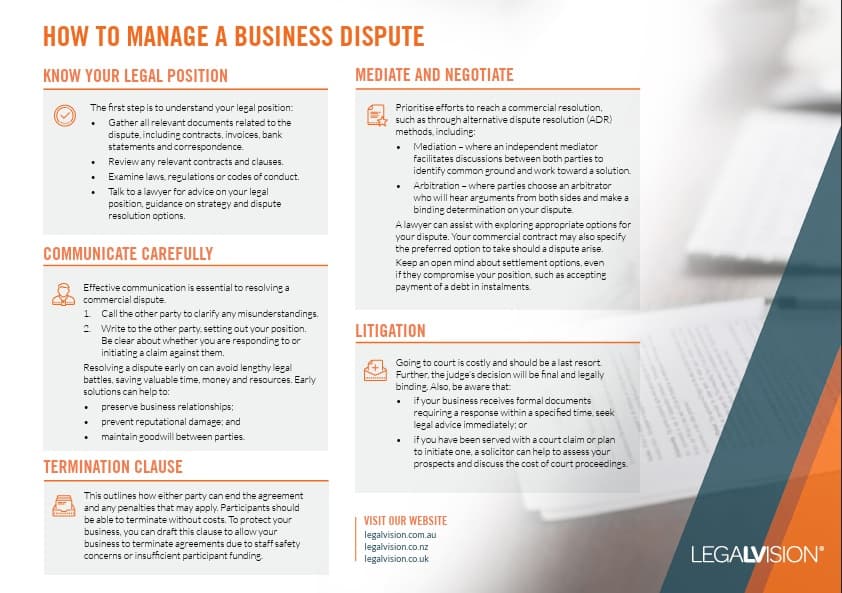
Learn how to manage and resolve your business disputes effectively.
Key Takeaways
As a director, you must stay involved in your company’s affairs. Know your company’s true financial position at all times. If insolvency looms, act quickly and take all necessary steps to prevent it.
LegalVision provides ongoing legal support for businesses through our fixed-fee legal membership. Our experienced dispute and litigation lawyers help businesses manage contracts, employment law, disputes, intellectual property, and more, with unlimited access to specialist lawyers for a fixed monthly fee. To learn more about LegalVision’s legal membership, call 1300 544 755 or visit our membership page.
Frequently Asked Questions
Can a director be personally liable for company debts?
Yes. Insolvent trading claims pierce the corporate veil, exposing directors to personal liability. This includes loss of property, bank accounts, and investment portfolios.
Does D&O insurance cover insolvent trading claims?
Generally, no. Most D&O policies exclude fraudulent or criminal conduct, leaving directors personally exposed.
What is the safe harbour defence?
It protects directors from civil insolvent trading liability if they took reasonable steps likely to produce a better outcome after suspecting insolvency, provided tax and employee obligations were met.
Can creditors directly sue directors for insolvent trading?
Yes. Creditors and liquidators can both bring compensation claims directly against directors, independent of any ASIC action.
We appreciate your feedback! Request your free consultation now.