
Summary
- From 1 July 2025, NDIS providers delivering Supported Independent Living (SIL) must be registered with the NDIS Commission, removing the previous exemption for unregistered providers.
- Unregistered providers currently delivering SIL must complete registration before the deadline or cease delivering the service.
- Registration requires meeting NDIS Practice Standards and undergoing a quality audit, which can be a lengthy process requiring early preparation.
- This article is a plain-English guide to mandatory NDIS registration requirements for SIL providers operating in Australia, prepared by LegalVision’s business lawyers.
- LegalVision, a commercial law firm, specialises in advising clients on NDIS compliance and provider registration obligations.
Tips for Businesses
Begin your NDIS registration process well before 1 July 2025, as audits and assessments take time. Review the relevant NDIS Practice Standards, engage an approved quality auditor early, and ensure your internal policies and procedures are documented and compliant before submission.


From 1 July 2026, all Supported Independent Living (SIL) and NDIS platform providers must register with the NDIS Quality and Safeguards Commission. This marks a significant shift, as both provider types can currently operate without registration. This article covers which providers are affected by mandatory NDIS registration and key considerations for the transition phase.
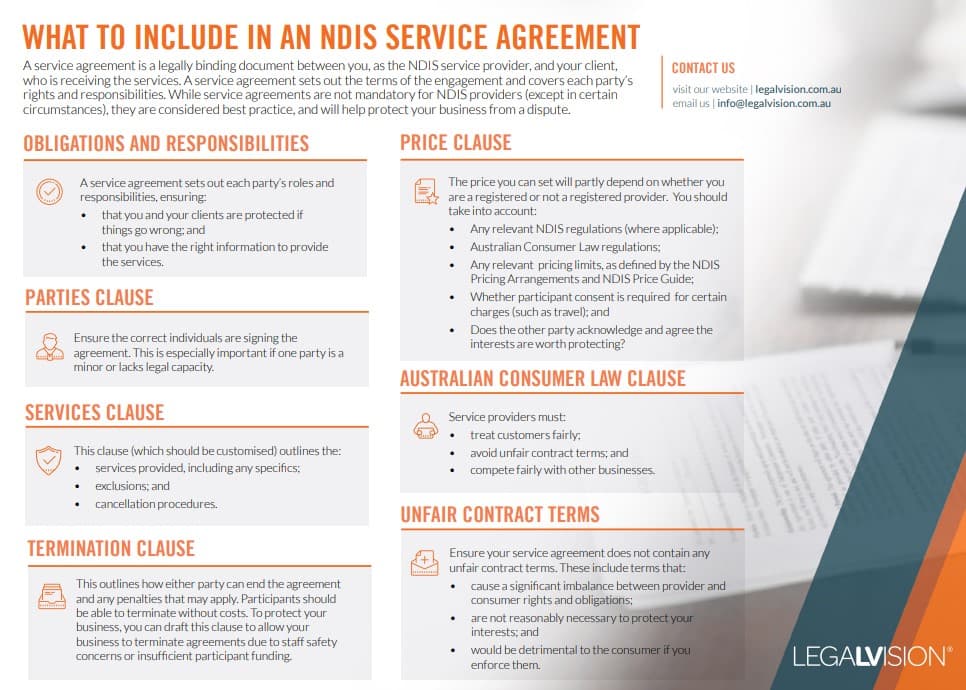
This fact sheet will help you to identify the key terms you must include in your NDIS service agreement.
What is an NDIS Platform Provider?
The NDIS Commission has not yet finalised the definition of a platform provider. Its inquiry describes providers using profile-based platforms to connect participants with workers through apps or websites. Platform providers can also be referred to as online, on-demand, or digital platforms.
A platform provider is an NDIS provider that collects funds from an NDIS-funded plan during its business operations. This means a platform provider can remain an NDIS provider even if it is not a party to the worker-participant service agreement.
Currently, platform providers can be either registered or unregistered NDIS providers.
What is a SIL Provider?
A SIL provider is an NDIS provider who delivers in-home support to help people with disabilities live as independently as possible. SIL supports can include personal care and other daily tasks like showering, dressing, cooking and cleaning. SIL supports can be delivered in a participant’s home, a shared home, or with Special Disability Accommodation. Participants who receive SIL support usually have complex needs.
Currently, SIL providers can be either registered or unregistered NDIS providers. It remains unclear what processes unregistered SIL providers must follow during the transition while applying for registration. New SIL providers may consider registering their SIL business when setting it up.
Continue reading this article below the formCall 1300 544 755 for urgent assistance.
Otherwise, complete this form, and we will contact you within one business day.
What Do I Need to Do Before 1 July 2026 if I Am a SIL or Platform Provider?
The Commission has said it will provide further guidance on transition arrangements in early 2026. It has also been stated that providers will have adequate time to prepare for mandatory registration. Providers should monitor the NDIS Commission website for further information as it is released.
Providers should also consult a lawyer and a regulatory consultant in advance to ensure they are prepared for the transition to mandatory registration.
Key Takeaways
The NDIS industry, laws and regulations are constantly changing to meet the needs of NDIS participants and providers. As part of these changes, SIL providers and platform providers will need to be registered with the NDIS Commission. The transition to mandatory registration will begin on 1 July 2026, and the NDIS Commission is expected to provide further guidance to help providers comply with this new requirement in early 2026. All current unregistered SIL and platform providers should start analysing their processes and procedures and preparing for registration and audits.
LegalVision provides ongoing legal support for all businesses through our fixed-fee legal membership. Our experienced NDIS lawyers help businesses across industries manage contracts, employment law, disputes, intellectual property, and more, with unlimited access to specialist lawyers for a fixed monthly fee. To learn more about LegalVision’s legal membership, call 1300 544 755 or visit our membership page.
Frequently Asked Questions
Who will need to register with the NDIS Commission from 1 July 2026?
From 1 July 2026, all Supported Independent Living (SIL) providers and NDIS platform providers must transition to mandatory registration. This includes currently unregistered providers in these categories who collect NDIS funds as part of their operations.
What should SIL and platform providers do to prepare for mandatory registration?
The NDIS Commission will release further guidance on transition arrangements in early 2026. Review their internal processes, and consider consulting lawyers and regulatory consultants to prepare for registration, audits, and ongoing compliance obligations.
Can a platform provider be unregistered currently?
Yes. Currently, platform providers can operate as either registered or unregistered NDIS providers.
What audits must registered providers undergo?
Registered SIL and platform providers must complete audits, suitability assessments, reporting obligations, and worker screening checks.
We appreciate your feedback! Request your free consultation now.