
Summary
- From 1 July 2026, Australian real estate businesses that broker, sell or transfer property may be required to enrol with AUSTRAC, implement a written AML/CTF programme and conduct customer due diligence before providing designated services.
- Businesses must identify and verify both buyers and sellers, screen for politically exposed persons and sanctions, and report suspicious matters – with civil penalties reaching up to $33 million for companies.
- AML/CTF checks must be built into the sales process early, as leaving them until settlement risks transaction delays, client disputes and regulatory exposure.
- This article is a plain-English guide to AML/CTF compliance obligations for Australian real estate businesses, prepared by LegalVision, a commercial law firm that specialises in advising clients on regulatory and compliance matters.
- LegalVision’s business lawyers outline the key steps businesses must take to meet their obligations under the reformed AML/CTF regime.
Tips for Businesses
Confirm whether your business is captured before 1 July 2026. Enrol with AUSTRAC, appoint a compliance officer and embed customer due diligence into your listing and onboarding processes. Train client-facing staff to recognise red flags and document all checks, escalations and decisions consistently.


On this page
- Does My Real Estate Agency Need To Comply With AML/CTF Laws?
- What Is an AML/CTF Check in Real Estate?
- Who Is Your Customer for AML/CTF Purposes?
- What AML/CTF Obligations Will Apply?
- AML/CTF Red Flags in Real Estate Transactions
- What Happens If Your Real Estate Business Does Not Comply?
- AML/CTF Compliance Checklist for Real Estate Businesses
- Three Key Next Steps
- Key Takeaways
- Frequently Asked Questions
From 1 July 2026, many Australian real estate businesses need to comply with anti-money laundering and counter-terrorism financing (AML/CTF) obligations. If the regime captures your business, you may need to enrol with AUSTRAC, operate under a written AML/CTF program, appoint a compliance officer, complete customer due diligence and report suspicious matters. The practical issue is not only whether you must comply. You also need to build AML checks into your sales process early to avoid delays, client frustration and settlement issues. This article outlines the key compliance requirements for real estate principals, licensees, buyer’s agents, developers and compliance leads.
Does My Real Estate Agency Need To Comply With AML/CTF Laws?
The AML/CTF reforms apply to real estate businesses that provide certain designated services and have a geographical link to Australia. Broadly, the regime can capture your business if you broker the sale, purchase or transfer of real estate for another person. It can also capture you if you sell or transfer real estate yourself in the course of carrying on a real estate business and no independent agent brokers the transaction.
| Real estate activity | Likely AML/CTF position |
| Acting as a seller’s agent or buyer’s agent | Likely to be captured. |
| Negotiating or facilitating property sales | Likely to be captured. |
| Selling off-the-plan apartments, house and land packages or subdivision lots through in-house sales staff | Likely to be captured. Developers should pay close attention, as using an internal sales team does not necessarily place the business outside the regime. |
| Brokering or selling long-term leasehold interests of more than 30 years | Likely to be captured. |
| Brokering, selling or transferring qualifying long-term leasehold interests in residential site arrangements | More likely to be captured where the relevant interest falls within the AML/CTF definition of ‘real estate’. This may apply to some residential site arrangements, but not every retirement village, caravan park or similar business will automatically be captured. |
| Residential property management only, such as rent collection, tenant management, maintenance coordination or routine leasing | Unlikely to be captured as a real estate designated service. |
| Short-term leases, easements, restrictive covenants and mortgage interests | Unlikely to be captured, as these may sit outside the relevant real estate definition. |
What Is an AML/CTF Check in Real Estate?
Real estate agents must undertake an AML/CTF check under the AML/CTF laws. An AML check is the process your business uses to confirm who your customer is, understand who owns or controls them, assess risk and decide whether you can safely act on their behalf.
AML checks matter because criminals can use property transactions to move, conceal or legitimise illicit funds. If you miss suspicious activity, fail to document your checks or proceed without proper escalation, you may face regulatory action, reputational damage and transaction disruption.
Continue reading this article below the formCall 1300 544 755 for urgent assistance.
Otherwise, complete this form, and we will contact you within one business day.
Who Is Your Customer for AML/CTF Purposes?
One common mistake is assuming that your AML/CTF customer will always be the person who formally engages you.
In a standard agency relationship, you may think only the vendor is your customer. However, AUSTRAC’s guidance indicates that, where you broker a real estate transaction, both the seller and buyer can be customers for AML/CTF purposes. This means your onboarding workflow may need different trigger points for sellers and buyers, rather than one generic customer-check process.
You should:
- map each transaction type your business handles;
- identify who you act for;
- identify who you deal with; and
- identify who receives the designated service.
This will help you design a practical onboarding process.
What AML/CTF Obligations Will Apply?
If the AML/CTF obligations apply to your business, your processes for onboarding clients, training staff, managing files and recording decisions must be compliant. Ensure you have an AML/CTF program, a compliance officer, staff training and processes that allow you to engage with customers and report suspicious matters. AUSTRAC has said it does not expect perfection immediately, but it does expect realistic plans and proactive efforts to manage AML/CTF risk.
Your business may need to take several steps to comply with Australia’s AML/CTF requirements, including:
- Enrol with AUSTRAC if required.
- Prepare a written risk-based AML/CTF program.
- Assess your business’s AML/CTF risks.
- Identify and verify customers.
- Identify beneficial owners.
- Conduct enhanced due diligence for higher-risk matters.
- Screen for sanctions and politically exposed persons (PEPs).
- Monitor transactions.
- Report suspicious matters.
- Keep accurate records.
The table below highlights some of the key considerations for real estate businesses when implementing AML checks.
| Issue | What it means for your real estate business |
| Timing will be the biggest operational change | AML checks need to be built into your sales process early, not left until settlement or the final stages of a transaction. |
| Customer due diligence should happen upfront | In most cases, you should complete initial customer due diligence before providing a designated service. |
| Limited exceptions may apply | Delayed customer due diligence may only be available in specific circumstances, such as auctions where the buyer is not known until towards the end of the real estate process. |
| Your process needs to reflect this | Design clear steps, so staff know when AML checks must be completed and when any exceptions may apply. |
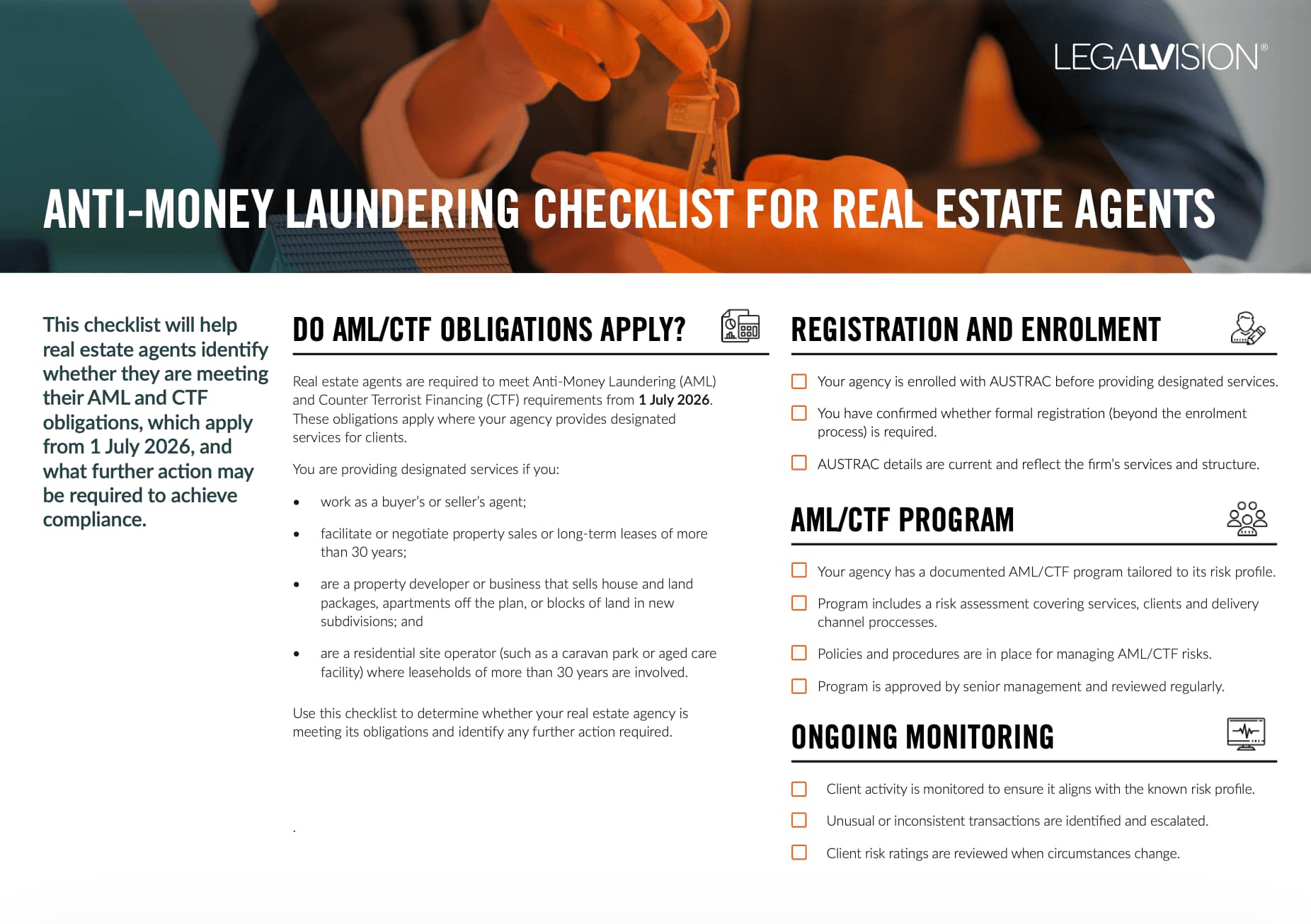
This checklist will help real estate agents identify whether they are meeting their AML and CTF obligations, which apply from 1 July 2026, and what further action may be required to achieve compliance.
AML/CTF Red Flags in Real Estate Transactions
Your staff do not need to prove money laundering before escalating a concern. They need to recognise warning signs that warrant further enquiry, such as unexplained cash purchases, third-party payments, rushed settlements, offshore entities, nominee arrangements or unexplained wealth.
These issues do not automatically mean a transaction involves criminal conduct. However, your business should ask further questions, document the response and consider whether it needs to report or escalate the issue.
What Happens If Your Real Estate Business Does Not Comply?
AUSTRAC can take enforcement action for AML/CTF breaches, including seeking civil penalty orders from the Federal Court. Civil penalties can reach up to 100,000 penalty units for a body corporate and 20,000 penalty units for a person other than a body corporate. Penalties can reach up to $33 million for a company and $6.6 million for an individual.
These are maximum penalties, not automatic fines. However, they show the scale of exposure for serious or repeated non-compliance.
AML/CTF Compliance Checklist for Real Estate Businesses
| Checklist Item | Key Questions and Actions |
| Are You Captured? | Ask whether your business brokers, sells or transfers real estate as part of a real estate business. You should also check whether you deal with long-term leasehold interests, residential site arrangements, off-the-plan sales, house and land packages or subdivision lots. If your business operates from Australia, uses an Australian bank account or has another relevant Australian connection, you should assess whether the regime applies. |
| Have You Enrolled With AUSTRAC? | Enrolment for newly regulated businesses opened on 31 March 2026. If your business provides designated services from 1 July 2026, you generally need to enrol with AUSTRAC within 28 days of commencing those services. Businesses already providing designated services on 1 July 2026 should enrol by 29 July 2026. Most newly regulated businesses only need to enrol, although remittance and virtual asset service providers may also need to register separately. |
| Do You Have an AML/CTF Program? | Your AML/CTF program should reflect the size, structure and risk profile of your business. It should explain how you identify customers, verify information, assess risk, escalate concerns, monitor transactions and keep records. |
| Have You Appointed a Compliance Officer? | Your compliance officer should have enough seniority and authority to oversee the program, respond to escalations and drive staff training. For larger businesses, they should also have clear access to directors, principals or senior management. |
| Have You Trained Client-Facing Staff? | Your staff need to know how to identify red flags, ask practical questions and escalate concerns. Training should cover common transaction scenarios, not only generic AML/CTF concepts. |
| Can You Keep Proper Records? | You should retain identity documents, verification results, risk assessments, escalation notes, training records and reporting decisions in a way that supports an AUSTRAC review or audit. |
Three Key Next Steps
- Start by mapping your transaction types. Identify where your business brokers sales, acts for buyers, sells directly through in-house teams or deals with long-term interests. This will help you decide where customer checks should begin.
- Move AML checks into onboarding.
- For seller-side work, build checks into the listing process.
- For buyer-side work, complete checks when you open the file or before substantive negotiation.
- For developers, embed AML checks into the sales reservation or contract preparation process.
- Create client-facing scripts. Staff need simple language to explain why your business may need to conduct ID checks, ask beneficial ownership questions and make source-of-funds enquiries. Do not rely on other parties. Conveyancers, banks and lawyers may have their own obligations, but they do not replace yours if your business is a reporting entity.
Key Takeaways
If your business brokers property sales, sells real estate directly through in-house staff or deals with long-term residential site interests, confirm whether you need to comply with AML/CTF laws from 1 July 2026. The most effective compliance approach is practical and early. Confirm your status, enrol with AUSTRAC if required, prepare a risk-based AML/CTF program, train your staff and build customer due diligence into your transaction workflow. Done properly, AML checks should support a cleaner, safer sales process rather than create a last-minute settlement blocker.
LegalVision provides ongoing legal support for businesses through our fixed-fee legal membership. Our experienced regulatory and compliance lawyers help businesses manage contracts, employment law, disputes, intellectual property, and more, with unlimited access to specialist lawyers for a fixed monthly fee. To learn more about LegalVision’s legal membership, call 1300 544 755 or visit our membership page.
Frequently Asked Questions
Do AML/CTF obligations continue after onboarding?
Yes. Your business may need to complete ongoing customer due diligence, monitor customer activity, report suspicious activity and maintain comprehensive records. Treat AML/CTF compliance as an ongoing process, not a one-off identity check.
Do AML/CTF checks affect our privacy obligations?
Yes. If you collect personal information for AML/CTF purposes, your business must handle that information carefully. Your privacy policy should explain how you collect, use, store and protect customer information obtained through AML/CTF checks.
What should an AML/CTF program cover?
Your AML/CTF program should explain how your business identifies and manages money laundering and terrorism financing risks. It should also cover customer checks, staff training, customer monitoring and how your team escalates suspicious activity.
Can AML/CTF laws apply to small businesses?
Yes. AML/CTF obligations apply based on the services your business provides, not only its size. If your business provides a designated service, you may need to enrol with AUSTRAC and comply with AML/CTF requirements.
We appreciate your feedback! Request your free consultation now.