
Summary
- Employees in Australia are entitled to carer’s leave to care for an immediate family or household member who is ill, injured, or facing an unexpected emergency.
- Full-time and part-time employees receive 10 days of paid personal/carer’s leave per year, while casual employees are entitled to two days of unpaid carer’s leave per occasion.
- Businesses must not dismiss or take adverse action against an employee for taking carer’s leave, provided the employee gives proper notice and evidence when required.
- This article is a plain-English guide to carer’s leave entitlements under Australian law, written for business owners and employers.
- It is produced by LegalVision, a commercial law firm that specialises in advising clients on workplace and employment law obligations.
Tips for Businesses
Maintain a clear leave policy that outlines notice and evidence requirements. Keep accurate records of leave taken. Treat carer’s leave requests consistently to avoid adverse action claims. Ensure managers understand that casual employees have separate, unpaid entitlements distinct from those of permanent staff.


Carer’s leave entitles employees to take paid or unpaid time off work to care for an ill or injured family member or household member. The Fair Work Act 2009 (Cth) sets out these entitlements, and employers must comply with them. This article outlines what leave entitlements employees have and how best to ensure that you are meeting your obligations.
What is Carer’s Leave?
Under the FWA, permanent employees are entitled to paid personal/carer’s leave. This paid entitlement does not apply to casual employees or contractors.
This entitlement forms part of the National Employment Standards (‘NES’). Personal/carer’s leave is available for permanent employees when they are unfit or unable to perform because they are:
- not fit for work due to a personal illness or personal injury; or
- required to provide care or support to a member of their immediate family or household due to a personal injury or illness, or an unexpected emergency.
This entitlement is equivalent to 10 days per year of service. It is important to note that this does not accrue automatically. Carer’s leave will accrue progressively throughout the year of service according to your employee’s ordinary hours of work.
What about Casual Employees?
Whilst casual employees are not entitled to paid carer’s leave under the NES, they are still entitled to two days of unpaid carer’s leave. Similar to paid carer’s leave, they may use this on each occasion a member of their immediate family or household requires care or support due to a:
- personal illness or injury; or
- unexpected emergency..
Who is in the Immediate Family?
An employee’s child always falls within this definition of immediate family. However, it is important for you to note that this entitlement extends to the care of:
- children of your employee’s current or former spouse or de facto partner that are not directly related to your employee;
- stepchildren; and
- adopted children.
Can I Ask for Proof?
Employees must provide you with notice that they are unable to attend the workplace due to their carer’s responsibilities and wish to take carer’s leave. This notice must:
- be given to you as soon as possible (which may be a time after the leave has started); and
- advise you of the period, or expected period, of the leave.
Similarly to when an employee seeks to take personal/carer’s leave when they are unfit to work due to injury or illness, you are permitted to ask for reasonable proof or evidence. This proof may include:
- proof of medical appointments;
- medical certificates from relevant medical practitioners; or
- a statutory declaration.
Whilst you may be permitted to ask for evidence and or proof, it may be best to operate on a discretionary basis to ensure a healthy working relationship with your employees. If your employees are covered by a modern award or enterprise agreement, these industrial instruments may include terms relating to what evidence they must provide.
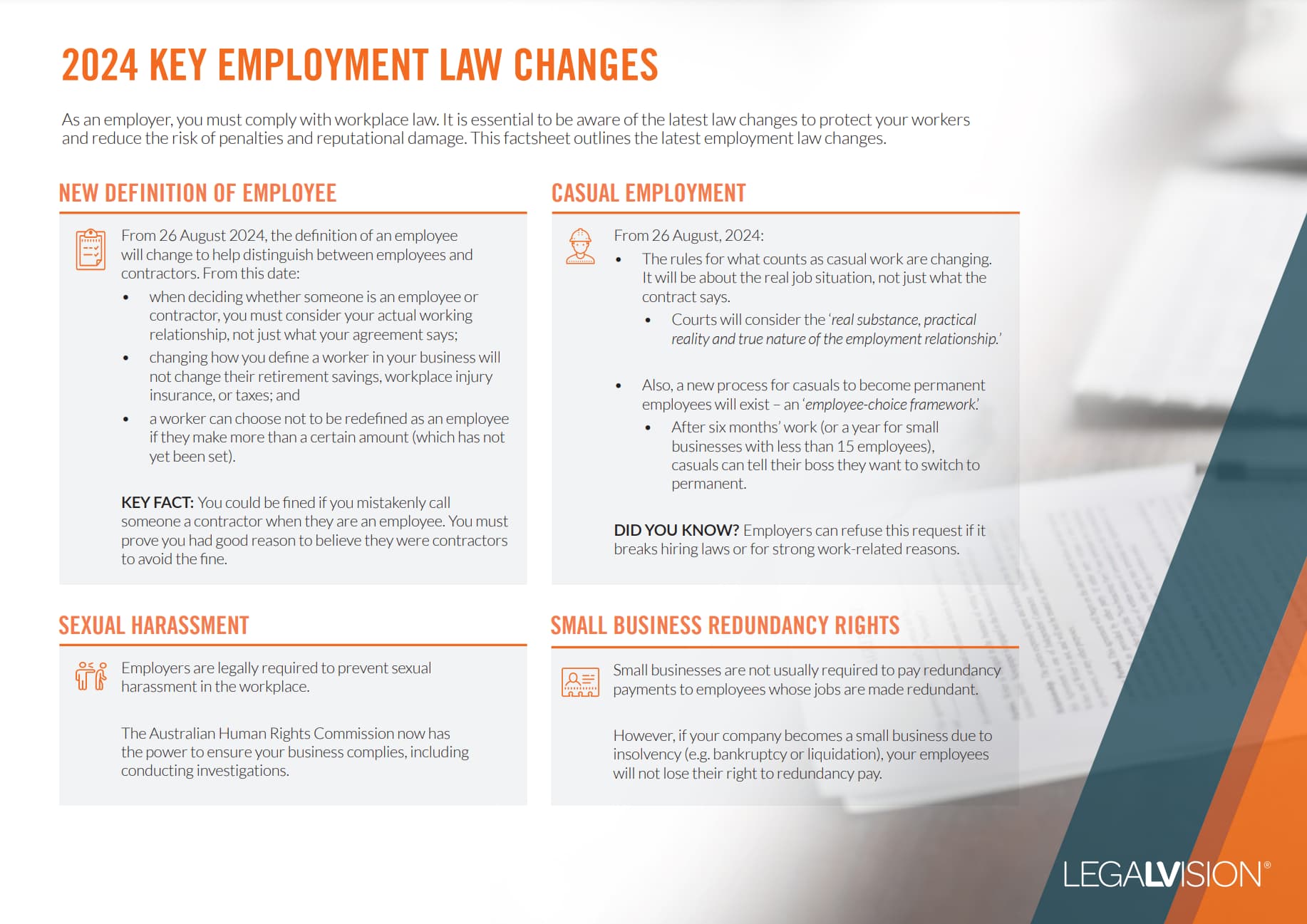
As an employer, it is essential to understand what employment laws have changed and their implications for your business — particularly the changes to the Fair Work Act 2009 through the new Closing the Loopholes legislation.
Call 1300 544 755 for urgent assistance.
Otherwise, complete this form, and we will contact you within one business day.
What Happens if an Employee Has No Accrued Carer’s Leave?
Under the Act, employees are entitled to up to two days unpaid carer’s leave for each occasion an immediate family member, such as a child, requires care or support. This period of leave can be taken either in:
- a single continuous period of up to two days; or
- separate periods if both you and the employee agree.
If an employee is required to care for their child or children for a period greater than two days, you and your employees may come to an agreement for the employee to take further unpaid leave. However, it is important to note that:
- employees do not accrue further entitlements such as annual leave whilst on a period of unpaid leave; and
- unpaid leave does not break an employee’s continuous service with your business.
Key Takeaways
The amount of carer’s leave your employee will be able to access depends on their type of employment and amount of accrued leave. As an employer, some key things you should remember moving forward include that:
- all employees have access to carer’s leave to look after their children;
- permanent employees are entitled to paid carer’s leave;
- casual employees are entitled to unpaid carer’s leave; and
- you can reasonably require your employees to provide you with notice and proof of their inability to attend work.
LegalVision provides ongoing legal support for businesses through our fixed-fee legal membership. Our experienced employment lawyers help businesses manage contracts, employment law, disputes, intellectual property, and more, with unlimited access to specialist lawyers for a fixed monthly fee. To learn more about LegalVision’s legal membership, call 1300 544 755 or visit our membership page.
Frequently Asked Questions
Can employees take carer’s leave for mental health reasons?
Yes, if a mental health condition constitutes a personal illness preventing work, employees can access personal/carer’s leave.
Does carer’s leave reset each year?
No, unused carer’s leave carries over and accumulates year to year.
Can an employer deny a carer’s leave request?
No, employers cannot deny carer’s leave if the employee meets the eligibility requirements under the NES.
Can employees take carer’s leave intermittently?
Yes, employees can take unpaid carer’s leave in separate periods if both parties agree.
We appreciate your feedback! Request your free consultation now.