Summary
- Australian small and medium businesses face growing payroll compliance risks driven by award complexity and increased employee scrutiny of wages using AI tools.
- Misclassifying employees under modern awards remains a leading cause of underpayment, exposing businesses to significant legal and reputational liability.
- Conducting early payroll audits and correcting errors promptly can meaningfully reduce a business’s exposure to underpayment claims.
- This article is a plain-English guide to payroll compliance obligations for Australian small and medium business owners, covering common underpayment risks and practical correction steps.
- It has been prepared by LegalVision, a commercial law firm that specialises in advising clients on Australian employment law and workplace compliance.
Tips for Businesses
Confirm which modern awards apply to each role and that classifications reflect actual duties. Check that employment contracts validly offset above-award pay against entitlements. Run regular payroll spot-audits and address errors promptly. Use compliant payroll systems to track penalty rates and seek legal advice where award coverage or calculations are uncertain.


Payroll compliance has entered a new phase for Australian small businesses, and the pressure is no longer coming only from regulators. Employees themselves are increasingly auditing their own pay using artificial intelligence tools, creating a new layer of scrutiny for employers already navigating a complex workplace relations system.
Against the backdrop of high-profile underpayment scandals across major Australian companies, workers are no longer assuming their wages are correct. Instead, many are uploading payslips and timesheets into AI systems to check penalty rates, classifications and overtime calculations. For some, the goal is reassurance. For others, it is to identify potential underpayment.
James True, who heads the Employment team at LegalVision, has witnessed this detective work firsthand. “There’s a huge uptake in employees interrogating their own wages, largely helped by AI products,” he says. “They can put their payslips and timesheets into an AI model and ask whether they’ve been underpaid.”
This shift is showing up in enforcement data. Anonymous tip-offs to the Fair Work Ombudsman surged by 50% in 2024–25 to more than 25,000, with around one-third coming from workers aged under 24. For small and medium business owners, the challenge is no longer simply avoiding payroll errors but detecting and correcting them before others do.
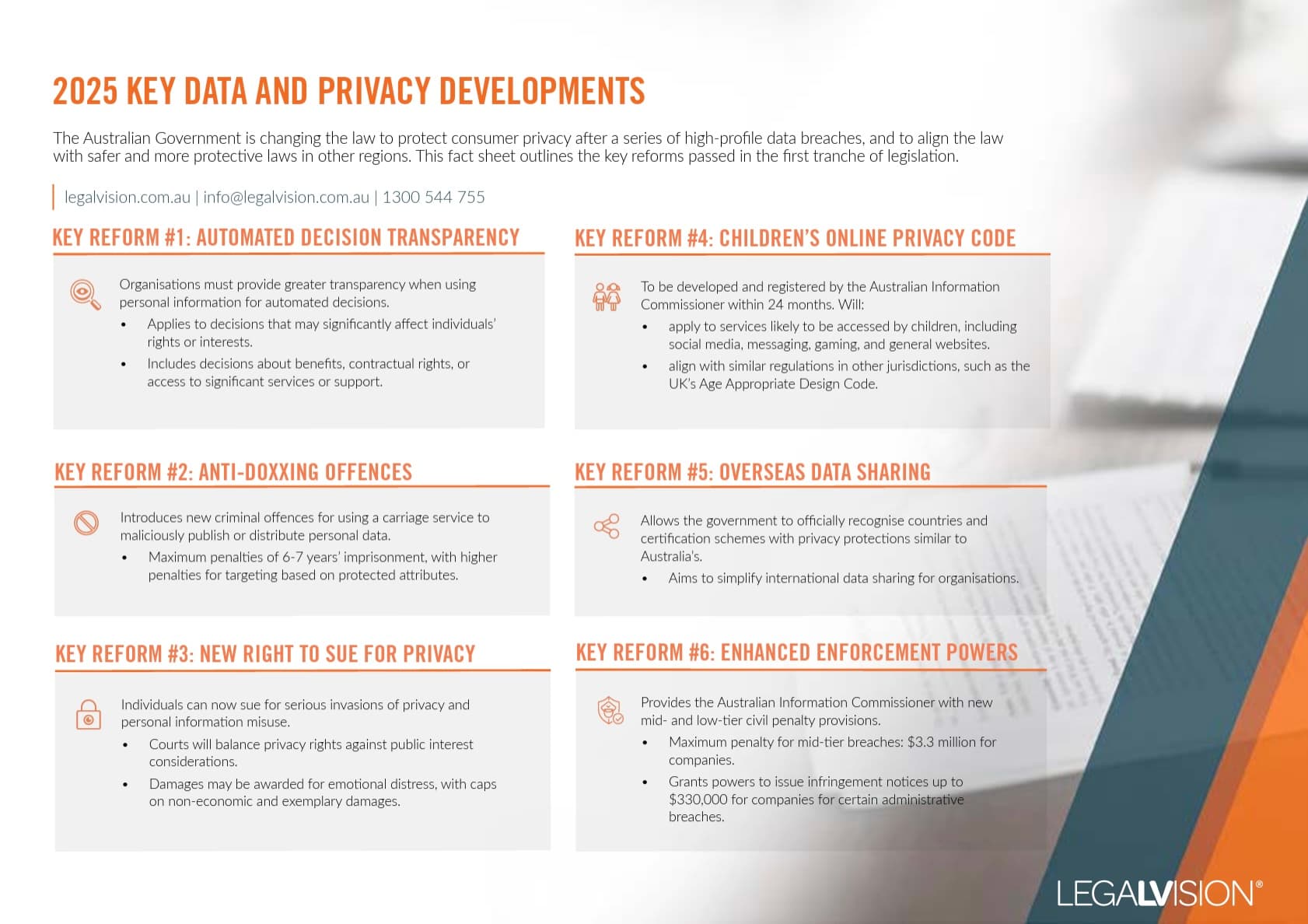
This factsheet outlines the Australian Government’s strengthened consumer privacy laws in 2025 following major data breaches and their alignment with global standards.
Complexity Makes Mistakes Easy
Australia’s industrial relations framework remains one of the most intricate compliance environments for employers, particularly for smaller businesses where owners often manage HR alongside other responsibilities. “It’s a very, very complicated sort of jurisdiction,” True explains. “There are over 120 modern awards.”
He regularly encounters business owners who are unaware that modern awards, which set minimum pay and conditions for specific roles, apply to their workforce. Others assume that no award applies to them because none exists for their industry.
In practice, awards can be applied by occupation rather than industry. Administrative staff are a common example. “If you’re in a private business and you’ve got employees who are doing admin-type duties where there’s no industry award that covers you… they’re probably going to get picked up by the Clerical Employees Award,” True says.
Frequent Award Missteps
Another frequent misstep is assuming only one award applies across an entire workforce. In reality, different roles within the same business may fall under different instruments. “You can have multiple awards applying,” says True. “It’s always a question of ‘Does it apply to both the employer and the employee?’ The employee’s particular duties are always relevant as well.”
Determining the correct award is rarely straightforward. “There’s nowhere to go beyond taking legal advice or HR advisory advice to find out what award applies. You can give the Fair Work Ombudsman a call, but they won’t give you any guarantees about whether the high-level answer they give you is binding in any way,” True warns.
Even employers who deliberately pay above-award wages can still breach compliance requirements if contracts are not drafted correctly. “You need some magic words in your employment contract that actually make sure that the payments you are making above award can be used to compensate the employee for all of those entitlements under the award,” True says.
Early Detection Can Contain the Damage
Recent underpayment cases involving some of Australia’s largest organisations demonstrate how payroll errors can escalate into large-scale liabilities even in well-resourced businesses, including:
- Woolworths;
- Coles;
- Qantas;
- Commonwealth Bank;
- Rockpool; and
- the University of Melbourne.
Causes have ranged from incorrect penalty calculations to systemic payroll system faults.
For smaller employers, the consequences often depend on who identifies the issue first.
“If you made a mistake in good faith, you can just rectify it, figure out what you were meant to pay and pay it back. Generally speaking, you can contain the issue just by doing that. You can resolve the headache by getting it right early,” says True.
The risk profile changes significantly if someone raises the problem externally. “If you find out because the Fair Work Ombudsman uncovers it, or because employees have uncovered it, then you’re on the back foot and more likely to potentially face prosecution,” True warns.
Payroll errors also multiply over time because they are usually embedded in systems or classifications rather than isolated events. “Your payroll liability will be one of the bigger ones in your business, and these claims can snowball,” True explains. “Suddenly, you’ve got 10, 20, 30, 40 employees all affected. You’re making a mistake every single month or week, however long the pay period is. That snowballs really, really, really quickly.”
Continue reading this article below the formCall 1300 544 755 for urgent assistance.
Otherwise, complete this form, and we will contact you within one business day.
Technology and Targeted Reviews Offer a Path Forward
Employment compliance sits within a broader regulatory burden for Australian businesses. The cost of meeting Commonwealth rules is estimated at $160 billion. Upcoming reforms such as Payday Super are expected to add further administrative and cashflow pressures for SMEs.
While legal advice remains the most reliable safeguard, True says businesses can take practical steps to reduce risk. The first is understanding core obligations, followed by periodic checks of payroll accuracy. “To limit the pain, you can do something like a spot audit. Take a small sample of employees and a small period of time and see whether you’re paying the right amounts.” This involves aligning actual duties with award classifications and pay rates.
Regulators and technology providers are also investing in tools to assist employers. The Fair Work Ombudsman has developed software to help identify applicable awards, and payroll platforms can automate calculations and record-keeping.
David Holland, Managing Director of Talent Solutions at Employment Hero, says automation has become essential infrastructure for smaller employers. “For SME owners, managing 120 modern awards manually isn’t sustainable. Technology can:
- automate award interpretation;
- map every hour worked against the latest rates and penalties in real time; and
- create a permanent audit trail that proves you’re meeting your obligations.”
“The businesses getting it right use technology for the heavy lifting, but stay engaged enough to spot issues when circumstances don’t fit the standard playbook.”
As employee-led scrutiny increases and risks intensify, payroll compliance has shifted from an administrative function to a core business risk. As True puts it: “Historically, issues in relation to underpayments may not have been seen as business critical, but that’s just not the case anymore.”
Key Takeaways
Employees are increasingly using AI tools to audit their own pay, driving a 50% surge in anonymous tip-offs to the Fair Work Ombudsman in 2024–25. Australia has over 120 modern awards, making payroll compliance complex, particularly for small businesses. Different roles within the same business may fall under different awards. Employers who pay above-award wages can still breach compliance if employment contracts lack correct wording. Identifying and correcting payroll errors early significantly reduces legal and financial risk. Payroll errors typically snowball quickly, affecting multiple employees over extended periods. Technology tools and spot audits can help businesses proactively manage compliance obligations.
Frequently Asked Questions
If the Ombudsman uncovers an underpayment before you do, you face a greater risk of prosecution compared to self-identifying and rectifying the error early.
Yes. Different roles within the same business can fall under different modern awards, depending on each employee’s specific duties.
A spot audit involves reviewing a small sample of employees over a short period to check whether you are paying correct amounts aligned to award classifications.
Payroll platforms can automate award interpretation, map hours against current rates and penalties, and maintain an audit trail demonstrating compliance obligations are met.
We appreciate your feedback – your submission has been successfully received.