
In Short
The ACCC is increasing enforcement action against NDIS providers for breaches of the Australian Consumer Law. Common issues include misleading claims that services are “NDIS approved”, unfair contract terms and improper billing practices. Providers face significant penalties, including fines of up to $50 million for corporations.
Tips for Businesses
Review your advertising, website and promotional materials to ensure you do not imply NDIA approval or guaranteed funding. Check that participant agreements comply with consumer guarantees and unfair contract term laws. Confirm supports align with each participant’s plan before charging. Keep clear records and update internal compliance processes regularly.
Summary
This article is a guide for Australian NDIS providers on their obligations under the Australian Consumer Law. LegalVision’s business lawyers explain the ACCC’s focus areas and compliance risks; LegalVision, a commercial law firm, specialises in advising clients on consumer law and regulatory compliance matters.


NDIS providers are under increasing scrutiny from the ACCC for breaches of the Australian Consumer Law (ACL). The regulator has identified widespread concerns in the sector, particularly misleading claims that products or services are ‘NDIS approved’. With penalties of up to $50 million for corporates, providers risk serious financial and regulatory consequences if they do not meet their consumer law obligations.
This article explains why the ACCC is targeting NDIS providers and outlines six key risk areas in advertising, contracts and billing practices that providers should review to reduce enforcement risk.
Why the ACCC Is Targeting NDIS Providers
In February 2026, the ACCC released a report identifying serious consumer law risks in the NDIS sector. Most complaints relate to false or misleading advertising, particularly providers incorrectly claiming their products are “NDIS approved”.
This reflects growing scrutiny of the sector in recent years. Since establishing its Fair Pricing and ACL Taskforce in December 2023, the ACCC has issued infringement notices totalling $118,800 and commenced court proceedings against several providers.
The ACCC is focusing on NDIS providers because participants rely on essential services and may be more vulnerable if consumer laws are broken. Wrongdoing can cause financial loss and affect participants’ safety and wellbeing. As investigations continue, providers should expect close checks of their advertising and contracts and review their compliance now.
Six key areas of concern are outlined below.
1. Misleading and Deceptive Conduct
Under the ACL, businesses must not make false or misleading claims about goods or services.
For NDIS providers, this often arises where marketing suggests products or services are ‘NDIS approved’ or ‘endorsed’. In reality, funding is assessed on a case-by-case basis based on each participant’s plan and needs. No product or service is automatically approved for all participants.
Providers should ensure:
- product descriptions are accurate;
- marketing does not imply NDIA endorsement; and
- claims about funding eligibility are clearly qualified.
2. False or Misleading Advertising
NDIS providers must ensure that their advertising material does not suggest that products or services are NDIS-approved or funded if they are not included on the NDIS Supports List. If a participant purchases supports based on misleading advertising and the NDIA later rejects the claim, you may be liable for the cost.
This risk is particularly relevant to:
- assistive technology suppliers
- respite and short-term accommodation providers
- therapy and allied health services
3. Consumer Guarantees
The ACL grants consumers basic rights that businesses cannot waive in a contract. This includes a guarantee that products are of acceptable quality and that services are provided with proper care and skill.
If these guarantees are not met, you must fix the problem promptly. For example, if a product has a major fault, the participant must be able to choose a refund, replacement or repair. These rights apply to both products and services, including allied health supports.
4. Unfair Contract Terms
Under the ACL, standard form contracts with participants must not include unfair terms. A term may be unfair if it gives the provider a much greater benefit or imposes unreasonable obligations on the participant.
Examples include:
- high cancellation fees;
- long notice periods to cancel; and
- very broad liability or indemnity clauses.
5. Wrongly Accepting Payment
You must not charge participants for products or services you do not intend to supply or cannot provide within a reasonable time. This includes charging for support hours you know you cannot deliver and for support that was not actually provided.
6. Concerns for Specialist Disability Accommodation (SDA) Providers
SDA providers must not mislead investors about NDIS funding. They should not suggest that the NDIS will guarantee a development or provide unconditional payments.
Investors should understand that:
- SDA payments stop if a property is vacant;
- payment levels depend on the dwelling type; and
- funding also depends on the eligible participant living there.
Ensure your business is compliant
To avoid the risk of an ACCC audit and intervention, it is crucial to ensure your advertising and participant agreements are compliant. NDIS providers must also confirm that:
- each support aligns with the NDIS Supports List;
- the support is covered by the participant’s plan before delivery;
- marketing complies with the ACL; and
- advertising does not imply NDIA approval or endorsement.
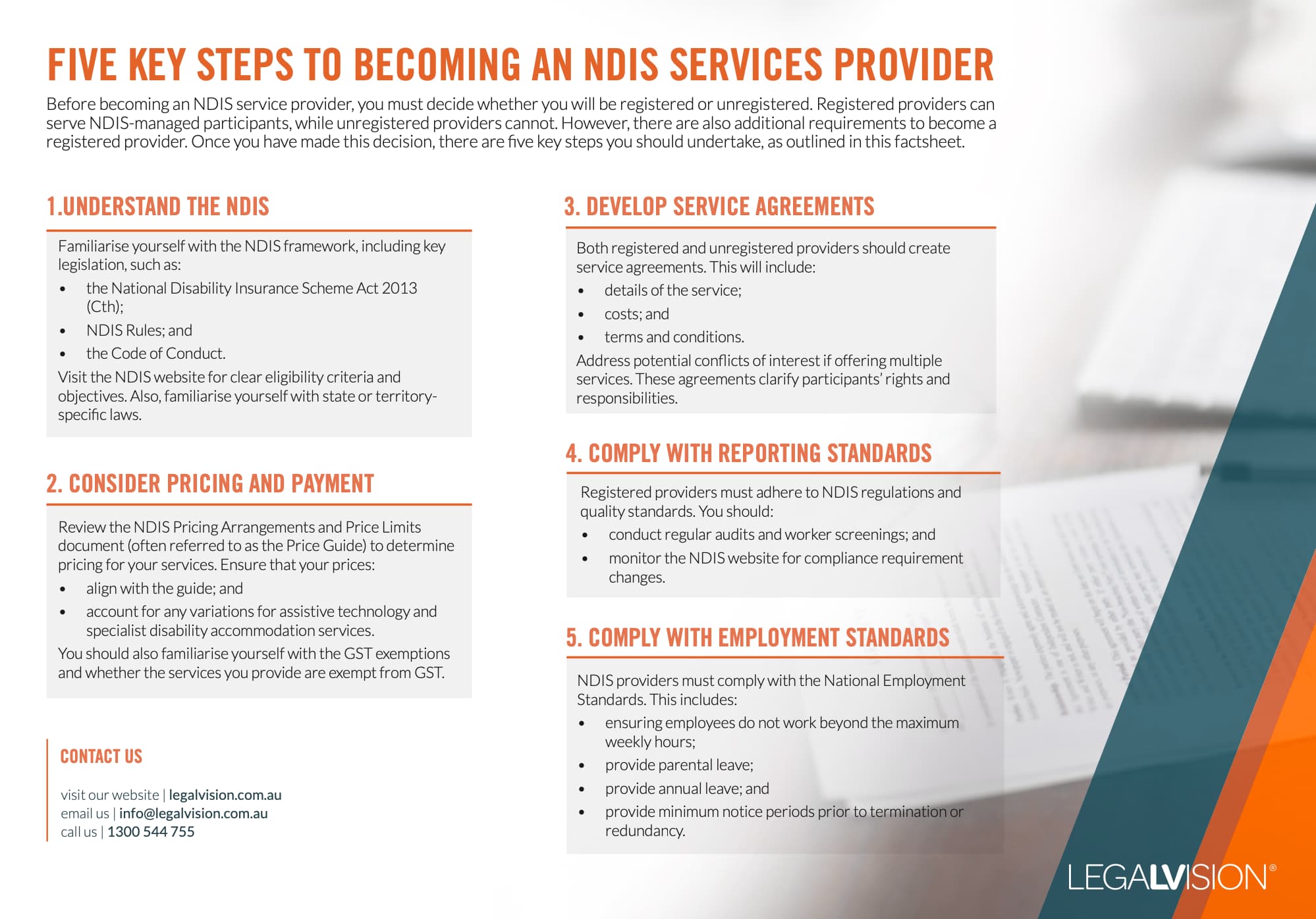
Understand five key steps you should know to become an NDIS service provider with this free LegalVision factsheet.
Call 1300 544 755 for urgent assistance.
Otherwise, complete this form, and we will contact you within one business day.
Key Takeaways
- The ACCC is cracking down on NDIS providers who fail to comply with the ACL in their dealings with participants.
- Substantial penalties are being imposed on providers who breach the ACL.
- Providers should expect ongoing scrutiny and seek legal advice to ensure they meet their obligations.
LegalVision provides ongoing legal support for businesses through our fixed-fee legal membership. Our experienced NDIS lawyers help businesses manage contracts, employment law, disputes, intellectual property, and more, with unlimited access to specialist lawyers for a fixed monthly fee. To learn more about LegalVision’s legal membership, call 1300 544 755 or visit our membership page.
Frequently Asked Questions
No. The NDIS does not approve or endorse specific products or providers. Funding is assessed on a case-by-case basis based on each participant’s plan and needs. Advertising must not suggest automatic eligibility or NDIA endorsement, as this may breach Australian Consumer Law.
The ACCC can issue infringement notices, seek court penalties, and require refunds or contract changes. Corporate penalties can reach up to $50 million. Participants may also claim remedies such as refunds or compensation. Regular compliance checks can help reduce enforcement risk.
We appreciate your feedback – your submission has been successfully received.